-

Support: globalsupport@kedacom.com
Sales: international.sales@kedacom.com -

-
Support: globalsupport@kedacom.com
Sales: international.sales@kedacom.com -
The low-altitude economy is flourishing, with the application scenarios for drones and other aircraft continuously expanding. Following the implementation of the Interim Regulations on the Flight Management of Unmanned Aircraft, the mandatory national standard GB 46750-2025 also officially took effect on May 1, 2026, explicitly requiring drone production to meet the "one aircraft, one code, full traceability" requirement, thereby imposing higher demands on airspace monitoring and governance.
In the face of an increasingly complex low-altitude environment, it is essential to both "hear" the identity broadcasts of drones and "see" the actual targets in the air. Kedacom's Broadcast Remote ID Receiver and Long-Range Electro-Optical Tracking PTZ — one "listening" and one "seeing" — together build the complete first link of low-altitude perception, providing a deployable perception capability foundation for drone management and control, low-altitude air traffic management, and critical site security operations.

Broadcast mode operational identification receiver
The equipment complies with the GB 46750-2025 national standard and offers excellent cost-effectiveness. It can receive operational information broadcast by compliant cooperative aircraft, collecting unique identification codes, positions, and flight speeds via WiFi and Bluetooth signals, enabling management personnel to grasp in real time the identity and flight trajectories of compliant aircraft within their jurisdiction, intuitively restoring the true flight situation in the airspace.
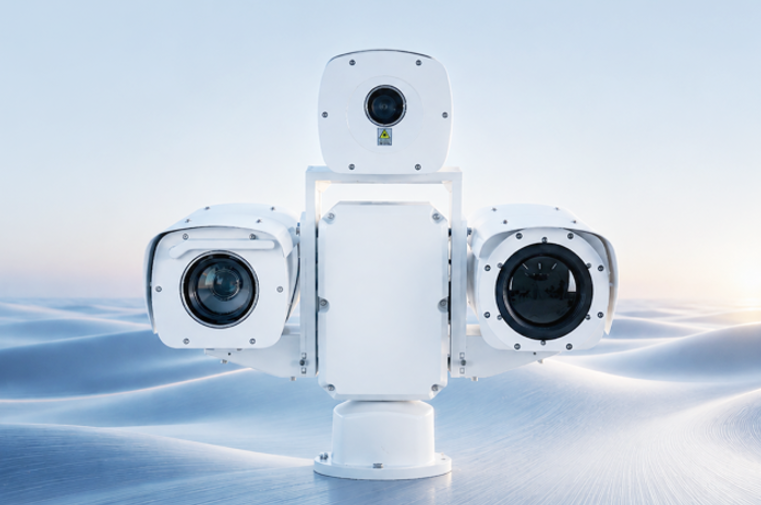
Long-Range Electro-Optical Tracking PTZ
Radio detection can obtain identity information of compliant aircraft, but for unidentified aircraft that do not broadcast signals, flocks of birds, and other targets, it becomes necessary to rely on electro-optical equipment to "see with one's own eyes." The Long-Range Electro-Optical Tracking PTZ integrates visible-light HD lenses with infrared thermal imaging. The visible-light channel supports up to 120x optical zoom and features optical defogging and OIS optical image stabilization, automatically tracking targets and conducting round-the-clock airspace search and detection while preserving evidence for later use.
Applied Scenarios
The prerequisite for effective control is visibility; the prerequisite for visibility is audibility. The two sets of equipment form complementary capabilities, with detection data uniformly aggregated to the low-altitude management and control platform, delivering synergistic value across different operational scenarios.
Large-Scale Event Security

Airport Clearance Zone Protection

Nature Reserve Zone Security

Security Monitoring for Photovoltaic Sites